
Was Herod Antipas A Jew
- Historical Background of Herod Antipas
- Herod Antipas and Jewish Identity
- Political Alliances and Influences
- Religious Practices and Beliefs
- Legacy and Impact on Judaism
Historical Background of Herod Antipas
Was Herod Antipas A Jew? Herod Antipas was a significant figure in the complex political landscape of the 1st century CE. Born in 20 BCE, he became the son of King Herod the Great and his wife Malthace, a Samaritan. His early life was steeped in a world of intrigue, power struggles, and cultural tensions, fundamentally shaping his approach to governance and his interaction with the Jewish populace.
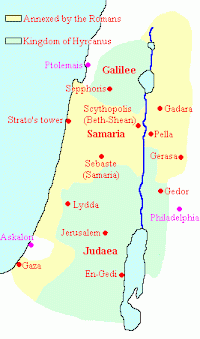
Herod Antipas ascended to power after the death of his father in 4 BCE, becoming the tetrarch of Galilee and Perea. His rule was characterized by a blend of Hellenistic culture and local traditions. As tetrarch, he was responsible for maintaining order in a region rife with conflict due to the competing influences of Rome, the Jewish aristocracy, and emerging religious movements. His reign also coincided with the turmoil surrounding the rise of early Christianity, a phenomenon that would profoundly impact the region’s socio-religious dynamics.
In his political tenure, Antipas made strategic decisions to solidify his power. He established a capital in Tiberias, named after the Roman Emperor Tiberius, signaling his allegiance to Rome. This choice was strategic, serving both as a demonstration of loyalty and as an attempt to cultivate Roman favor. However, Tiberias was also controversial among the Jewish population due to its location on the Sea of Galilee and its association with the city’s pagan practices.
No products found.
Throughout his governorship, Antipas faced numerous challenges, not least of which was the balancing act between appeasing his Roman overlords and maintaining the fragile peace with his Jewish subjects. His lineage as the son of Herod the Great linked him to a legacy of autocratic rule, but the fervent nationalistic sentiments among the Jews put pressure on his regime. The political landscape was complicated further by rival claimants to power and the rising tides of opposition from various factions, including emerging Jewish sects such as the Pharisees and the Essenes.
Antipas’s marital alliances were also politically motivated. His ill-fated marriage to Herodias, the wife of his half-brother Philip, brought scandal and political strife. This alliance alienated many in the Jewish community, who viewed it as an affront to their cultural and religious values. The marriage was often cited as an example of Antipas’s disregard for Jewish law, a critical point in debates around his identity as a Jew. The marriage ultimately became a focal point in the ministry of John the Baptist, culminating in a tragic series of events that led to John’s execution—a decision that illustrated the lengths to which Antipas would go to maintain his political stature, even at the cost of his ethical and cultural obligations.
In discussions about whether Herod Antipas was a Jew, it is essential to understand that his heritage placed him within a Jewish context, yet his actions often contradicted the expectations of Jewish leadership and morality. His governance relied heavily on Hellenistic ideals and tactics that were at odds with the prevailing Jewish customs. This dichotomy raises important questions regarding his commitment to Jewish identity and the extent to which he prioritized personal ambition over his cultural and religious responsibilities.

As we delve deeper into the life of Herod Antipas, we must consider the implications of his authority and the lasting impact of his decisions on the Jewish community and the broader historical narrative. The tensions that arose during his rule not only reflect his personal governance style but also hint at the complexities of identity and loyalty in a time when the lines between cultural heritage and political allegiance were fiercely contested. Understanding Antipas’s historical context provides crucial insights into the evolution of Jewish identity and the political landscape of Judea during this tumultuous period.
No products found.
Herod Antipas and Jewish Identity
Herod Antipas, primarily remembered for his political maneuvering during an era of great turmoil, posed a unique challenge to the Jewish identity conversation. His mixed lineage, being part Jewish and influenced by Hellenistic culture, sets the stage for an examination of his affiliations and self-identification. Despite the complexities of his background, the prevailing question remains: Was Herod Antipas a Jew?
From a genealogical perspective, Antipas was born to Herod the Great, who converted to Judaism and ruled as a king of the Jews. His mother, Malthace, was a Samaritan, which further complicates a straightforward identification with Jewish identity. While he was born into a family that occupied the highest echelons of Jewish society, his upbringing in a court steeped in Hellenistic culture and his actions as an adult often drew skepticism and criticism from the Jewish populace.
Antipas’s governance style reflected a significant Hellenistic influence, exhibiting values and practices that diverged from normative Jewish law. His founding of Tiberias is illustrative of this. The city, populated with Roman settlers and steeped in Greco-Roman customs, faced backlash from the Jewish community, which viewed it as a symbol of assimilation and deviation from traditional beliefs. This act, rather than solidifying his Jewish identity, weakened it in the eyes of many, as it seemed to prioritize Roman cultural values over those rooted in Jewish heritage.
Moreover, Antipas’s marriage to Herodias raised further questions regarding his commitment to Jewish legal standards. The union was seen not just as politically motivated but also as a transgression of the Levitical laws regarding marriage and divorce. Many Jewish leaders and sects, particularly the Pharisees, strongly opposed his actions. This scandal had not only personal ramifications for Antipas but also contributed to wider discussions about the legitimacy of his claim to Jewish identity, as it exemplified a departure from traditional Jewish values.
No products found.
The complex relationship between Antipas and the Jewish community extended beyond personal actions to include his governance. Reactions to his policies often led to unrest, particularly among those who adhered strictly to Jewish law. His reliance on Hellenistic diplomacy and infrastructure—such as his attempts to integrate aspects of hellenized governance—further estranged him from certain factions within the Jewish population. The animosity toward him culminated in his confrontation with figures like John the Baptist, whose condemnation of Antipas’s actions illustrated a significant division in Jewish perspectives on leadership and morality. The eventual execution of John served not only as an important moment in Antipas’s rule but also as a turning point in how he was perceived by the Jewish people.
In the ongoing discourse regarding whether “Was Herod Antipas A Jew,” one must carefully contemplate his actions and their implications. The historical record shows a man torn between his heritage and the political realities of his time. As he navigated the tumultuous waters of Hellenistic and Jewish interactions, Antipas often placed his political ambitions above the cultural norms of the community he ostensibly governed. This dynamic ultimately constructed a fragmented identity, reflecting a ruler more concerned with maintaining power than embracing the spiritual and cultural ethos of Judaism. The struggles surrounding his identity highlight not only the challenges of establishing authority in a divided society but also the intricate layers of identity within the ancient world.
Political Alliances and Influences
Antipas’s political landscape was intricately aligned with a network of alliances that shaped not only his rule but also the perception of his identity among his Jewish subjects. A key aspect of this was his relationship with Rome, which played a significant role in determining his policies and governance strategies. The ties he cultivated with Roman elites allowed for a degree of autonomy, but they came with the expectation of loyalty to Roman interests, which often clashed with the traditional values upheld by the Jewish community.
Roman Influence and Governance
Herod Antipas’s governance was marked by a careful balancing act between local Jewish traditions and the overarching dictates of Roman authority. His appointment as tetrarch was a clear indication of Rome’s trust in him, but it also placed Antipas in a position of need to navigate a delicate political situation. The demanding expectations of Roman rule required Antipas to demonstrate allegiance in various forms, including the construction of cities that honored Roman culture and principles.
One of the most notable examples was his establishment of Tiberias. While strategically located and aimed at enhancing administrative efficiencies, the city’s foundation was met with hostility from the Jewish populace. It was seen as an act of cultural capitulation, a physical reminder of Hellenistic encroachment. The choice to develop a capital city in such a manner not only alienated segments of the Jewish community but also sparked debates on Antipas’s identity and the authenticity of his connection to his heritage—raising critical questions surrounding whether “Was Herod Antipas A Jew.”
| Year | Event | Outcome |
|---|---|---|
| 4 BCE | Herod Antipas becomes tetrarch | Continues father’s legacy but faces Jewish resistance |
| 20 CE | Construction of Tiberias | Increased tension with Jewish communities |
| 31 CE | Execution of John the Baptist | Heightened conflict with Jewish sects, especially the Pharisees |
These decisions were commonly viewed as prioritizing Roman interests over the sentiments of his Jewish subjects, which exacerbated existing tensions regarding Antipas’s identity. His need to maintain favor with the Roman elite led to actions that further distanced him from his heritage, complicating his standing in the eyes of the Jewish populace, who was in search of a leader that genuinely represented their values and traditions.
Strategic Marriages and Political Consequences
Antipas’s marriage to Herodias brought additional complexities to his rule and further affected his identity perception amongst the Jews. This union, which violated Jewish law prohibiting marriage to a brother’s wife, became a source of scandal that reverberated throughout his reign. The ethical contradictions embodied in this relationship highlighted a fundamental disconnect between his personal choices and the expectations of his role as a ruler among the Jewish people.
Despite the political advantage that such a marriage might provide—aligning himself with influential families—it irrefutably compromised Antipas’s claim to genuine Jewish leadership. The backlash he faced emphasized the rift between his political necessities and societal norms within the Jewish community. John the Baptist’s vocal opposition to the marriage not only underscored the dissatisfaction with Antipas’s governance but also amplified the scrutiny on his identity.
As this scandal culminated in the execution of John the Baptist, the fallout had far-reaching implications. Antipas gained a notorious reputation for prioritizing his political security over ethical governance for the Jewish people. His actions reinforced skepticism surrounding whether “Was Herod Antipas A Jew” was a question that could be answered in the affirmative, as the divide between his policies and Jewish tradition grew more pronounced.
As Antipas balanced these various alliances and public sentiments, his identity became increasingly fractured, reflecting the complexities of leading a diverse population caught between competing cultural ideologies. Thus, through the lens of political alliances and influences, Antipas’s story reveals a ruler at odds with his lineage and the expectations that came with it, creating a legacy of ambiguity in terms of religious and cultural identity within the annals of history.
Religious Practices and Beliefs

Engagement with Jewish Religious Practices
Herod Antipas’s relationship with Jewish religious practices was marked by a tension that reflected his broader conflict between allegiance to Roman customs and his Jewish heritage. Despite his lineage, Antipas’s actions often diverged significantly from Jewish laws and traditions, contributing to the ongoing debate about whether Was Herod Antipas A Jew. For instance, his political decisions often overshadowed religious observances, and his governance displayed a clear proclivity toward Hellenistic ideologies that diverged from conventional Jewish teachings.
Antipas’s construction of Tiberias, a city founded on Greco-Roman principles, is a prime example of this conflict. The city incorporated aspects inconsistent with Jewish customs, such as the introduction of pagan temples and an overall culture that was considered antithetical to Jewish values. Many Jews resented this shift and viewed the city’s establishment as a significant departure from their religious identity. Consequently, Tiberias symbolized the struggle between Jewish identity and external cultural pressures, perhaps leading some to question the genuineness of Antipas’s Jewish identity. Historical evidence suggests that he regarded his political goals as paramount, often at the expense of traditional Jewish obligations.
Moreover, Antipas’s frequent disregard for Jewish law, especially in relation to his marriage to Herodias, emphasized this disconnection. The marriage not only breached Levitical regulations but also resonated negatively with Jewish leaders and sects who held fast to traditional practices. The criticism he faced from figures such as John the Baptist illustrated this rift and brought his identity as a Jewish leader into sharp focus. These challenges accentuated the narrative around whether Was Herod Antipas A Jew, as his choices were viewed as manifestations of betrayal against the very customs he was born into.
Influence of Emerging Sects
During his reign, Herod Antipas encountered various emerging Jewish sects, particularly the Pharisees and the Sadducees, whose beliefs and practices conflicted with his Hellenistic tendencies. The Pharisees, known for their strict adherence to Jewish law and traditions, were particularly vocal in their opposition to Antipas. This pivotal relationship between Antipas and these sects significantly contributed to the tensions surrounding his governance and further obscured his identity as a Jewish leader.
The emergence of early Christian movements during his rule also had profound implications for Antipas’s legacy. As Jesus began his public ministry, the encounters between him and Antipas highlighted the dichotomy between Roman influence and Jewish expectations. The eventual execution of John the Baptist, largely at the behest of Antipas, further complicated matters, as it not only ignited dissent within the Jewish community but also aligned him against a figure who sought to uphold traditional moral standards. This confrontation revealed the growing chasm between his identity and the religious aspirations of many of his contemporaries.
Reports suggest that the tensions between Antipas and these religious groups escalated to the extent that they not only opposed his reign but also questioned the legitimacy of his rule. The situation intensified further with Jesus’s growing popularity, leading some to regard Antipas as a symbol of compromised Jewish identity. Therefore, the question of Was Herod Antipas A Jew gains additional complexity through his interactions with these various religious factions; his policies and practices often stood in contrast to the expectations and aspirations of the broader Jewish community.
Legacy of Religious Strife
Herod Antipas’s reign left behind a legacy marked by religious strife and discontent among the Jewish populace. The frequent climaxes of tension led to various uprisings and dissent throughout his rule, calling into question not only his leadership effectiveness but also his commitment to Judaism. The conflict exemplified the broader struggles within Judea, as traditional Jewish values found themselves challenged by the Hellenistic influences that Antipas championed.
The fallout from Antipas’s choices laid a complex foundation for later Jewish leaders, ultimately affecting the religious landscape for generations to come. His prioritization of political ambition over the adherence to Jewish law negatively impacted his legacy and complicated religious discourse, creating an environment where the question “Was Herod Antipas A Jew” remained problematic. The fallout from his governance set a precedent that would shape how future rulers were viewed in relation to their cultural and religious identities, mapping an indelible impact on Jewish history.
The intertwining of politics and religion during Antipas’s reign serves as a potent reminder of how leadership can profoundly affect community identity and beliefs. His inability to reconcile the two realms not only tarnished his reputation but also set the stage for ongoing debates about the nature of Jewish identity in a fractured political landscape. As these questions persisted through the years, they underscored the complexities of maintaining a coherent identity in an era defined by cultural crosscurrents and competing ideologies.
For more insights into the complexities of Jewish identity in the Judean context, you can explore Jewish Identity in the Diaspora and the significance of cultural influences at Judaism in the Greco-Roman World.
Legacy and Impact on Judaism
The policies and actions of Herod Antipas during his reign significantly impacted the Jewish community, shaping the legacy he left behind. The complexities surrounding his identity as a ruler who straddled both Jewish and Hellenistic cultures invite critical reflection on the question, “Was Herod Antipas A Jew?” His decisions often led to religious strife and dissent, and his legacy is marred by a perceived betrayal of Jewish values.
Antipas’s establishment of Tiberias is one notable instance reflecting his challenging relationship with Jewish identity. The city, founded on Greco-Roman ideals, was not merely a political gesture but a physical embodiment of cultural displacement for many Jews. This act alienated segments of the populace who viewed Tiberias as a hub of paganism and an affront to their heritage. The ensuing tensions contributed to a broader narrative wherein Antipas was often seen as prioritizing his political ambitions over his cultural and religious obligations. This priority raised significant questions about his commitment to Judaism, particularly when the city became synonymous with a lifestyle that contradicted traditional Jewish laws and customs.
The interactions between Antipas and various emerging Jewish sects added another layer of complexity to his legacy. His relationship with the Pharisees, who were adamant about upholding Jewish law, was particularly fraught. The Pharisees viewed Antipas’s policies as reflecting a blatant disregard for the Torah and traditional authority. This opposition not only highlighted tensions within Jewish society but also marked Antipas as a ruler whose reign fostered division rather than unity. The question “Was Herod Antipas A Jew?” becomes particularly relevant in this context, as his actions were often perceived as subversive to the very identity he was born into.
Moreover, the cultural and religious ramifications of Antipas’s marriage to Herodias cannot be understated. This union violated Jewish laws that prohibit such marriages, and it served as a flashpoint for multiple conflicts during his rule. Figures like John the Baptist openly criticized Antipas for this relationship, further highlighting the king’s estrangement from Jewish customs. The execution of John, although politically motivated, deepened the divide between Antipas and the Jewish community, amplifying the perception that he was unfit to lead as a representative of the Jewish people.
The legacy of religious conflict during Antipas’s rule reverberated through subsequent generations, creating an atmosphere of skepticism surrounding leadership claims that lacked genuine adherence to Jewish practices. His attempt to navigate between Hellenistic expectations and Jewish traditions ultimately synthesizes into a narrative of conflicted identity.
As Antipas’s reign unfolded, the influence of emerging Christian movements added further complexity to his legacy. The growing popularity of Jesus and the early Christians emphasized the contrasts between Antipas’s governance style and the aspirations of many Jews. The tension surrounding these dynamics serves as a reminder of how Antipas’s actions not only impacted his standing among his contemporaries but also shaped the future of Jewish religious and cultural identity in a time of significant transition.
In retrospect, Herod Antipas’s legacy is defined by a series of decisions that perpetuated conflict between his dual heritage and the expectations of leadership within the Jewish community. The question “Was Herod Antipas A Jew?” encapsulates the broader struggles he faced in reconciling political power with cultural integrity. His governing style, marred by scandal and controversy, left an indelible mark on the historical discourse surrounding Jewish identity, raising critical reflections that continue to inform our understanding of this pivotal period in history.






Post Comment